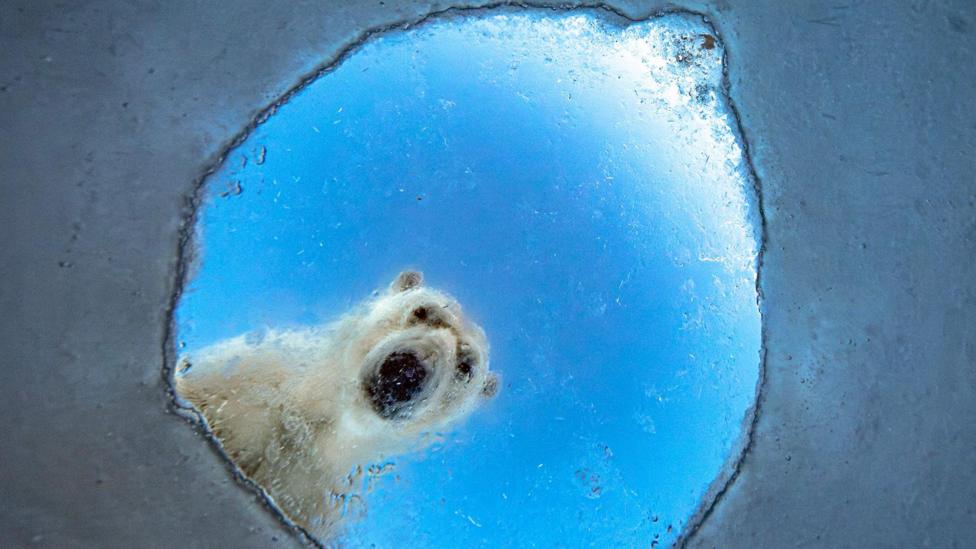
Organizers of the prestigious Wildlife Photographer of the Year competition have revealed a fresh batch of highly commended images, offering a preview of the exceptional photography set to be featured in the upcoming exhibition. Among the standout entries is a striking portrait captured by Norwegian photographer Audun Rikardsen, who managed to photograph a curious polar bear from an unusual vantage point.
Working in Kvænangen within Troms County, Norway, Rikardsen set out to document wildlife while collaborating with Arctic Wildlife Tours. He deployed an underwater camera equipped with a motion sensor directly beneath a natural breathing hole used by seals. Positioning himself to wait, the photographer watched as a female polar bear eventually wandered over to the spot in the early morning hours and peered downward into the water.
Because the massive predator lingered near the equipment, Rikardsen had to wait several hours before he could safely retrieve the gear. Upon checking the resulting files, he was thrilled to discover a rare view of the Arctic predator mimicking what a seal might see beneath the ice. The entry, titled Icy Window, secured a highly commended spot in the animal portraits category.
This is not the first time Rikardsen has achieved recognition in the international competition. He previously claimed category victories in both 2019 and 2025.
The preliminary showcase also highlights several other remarkable scenes from around the globe. In Norway, a drone operator for the Norwegian Orca Survey documented a heartbreaking display when an adult killer whale was seen carrying the carcass of a dead calf through a fjord. Researchers note that such grief-related behavior, where cetaceans transport deceased offspring for extended periods, has been documented before and may be more common across the species than previously understood.
In Central America, wildlife photographers captured an unexpected juxtaposition when a tiny mosquito came to rest on the head of a venomous fer-de-lance viper in Costa Rica. The intricate macro shot required demanding focus-stacking techniques to execute successfully. Meanwhile, in the Brazilian Pantanal, another photographer documented a black vulture feeding on a caiman carcass shortly before a jaguar emerged from the surrounding brush to take over the meal.
Additional recognized works feature a slow-shutter capture of an urban-adapted Eastern Japanese toad traversing a city street after rainfall, and swift birds cutting through the skies above London following their seasonal migration from Africa.
The complete roster of winners and the overall competition champions will be officially revealed on Tuesday, October 13, 2026. Following the announcement, a public exhibition showcasing the shortlisted and winning photographs will open at the Natural History Museum in London on Friday, October 16, 2026.
Reporting based on coverage first published by BBC News. Read the original report at BBC News.


